

When considering online education, parents and students may be overwhelmed by the thought of sitting in front of a screen for 6 hours a day. They envision eye strain, passive learning, and diminishing motivation. What if I were to tell you, though, that the most memorable online classes that I teach at NorthStar Academy are primarily accomplished offline?
I’ve been a teacher for more than 25 years, working in private and public schools, brick-and-mortar and virtual, always on the quest for meaningful learning experiences for my students. In recent years, I’ve had the privilege of creating courses at NSA that provide rich and engaging opportunities, particularly Culinary Arts and Watercolor Painting, where students literally get their hands dirty while completing their coursework and crafting creations… far away from the screen.
Not all online schools offer the same balance between on-screen learning and hands-on activities. Last year, my daughter took an online culinary arts class through her public school, and despite learning the theory of dicing, slicing, and cooking food, she didn’t actually make a single recipe all semester. She admittedly liked getting “easy credits,” but I was incredibly disappointed that a student could graduate with Culinary Arts on their transcript without the experience of cooking anything… not to mention that our family didn’t benefit from the cookies, cakes, and muffins that we’d all hoped she’d bake!
If students are to get anything valuable out of school, gaining knowledge and skills that they’ll actually use, they need to truly engage with the learning material; this means they should be involving their hands, bodies, and minds as part of the learning. This is not a new idea. In fact, good old common sense tells us that we retain more learning from physically “doing” something, rather than just reading or watching it. Have you noticed that anytime you’ve needed to perform a skill (like asking where the bathroom is in another language while traveling), or complete a process (like changing a tire), the knowledge “sticks” for longer?
On the other hand, you’ve probably experienced the opposite too: you’re reading something new, but as soon as you walk away, the knowledge is gone! You can read information and possibly even pass a quiz on the topic shortly thereafter, but it seems like the learning doesn’t stick in your long-term memory. And yet, despite how unsuccessful this learning model is for most students, this is exactly how old-fashioned, traditional or distance-learning courses are often structured: read and answer questions. Memorize and take a quiz. Recite it and forget it.
Check out how we incorporate active learning in Culinary Arts, Painting 1, Drawing 1, and so many more classes at NorthStar Academy! For example, look at this beautiful meal prepared by one of our students as his final project in Culinary Arts:
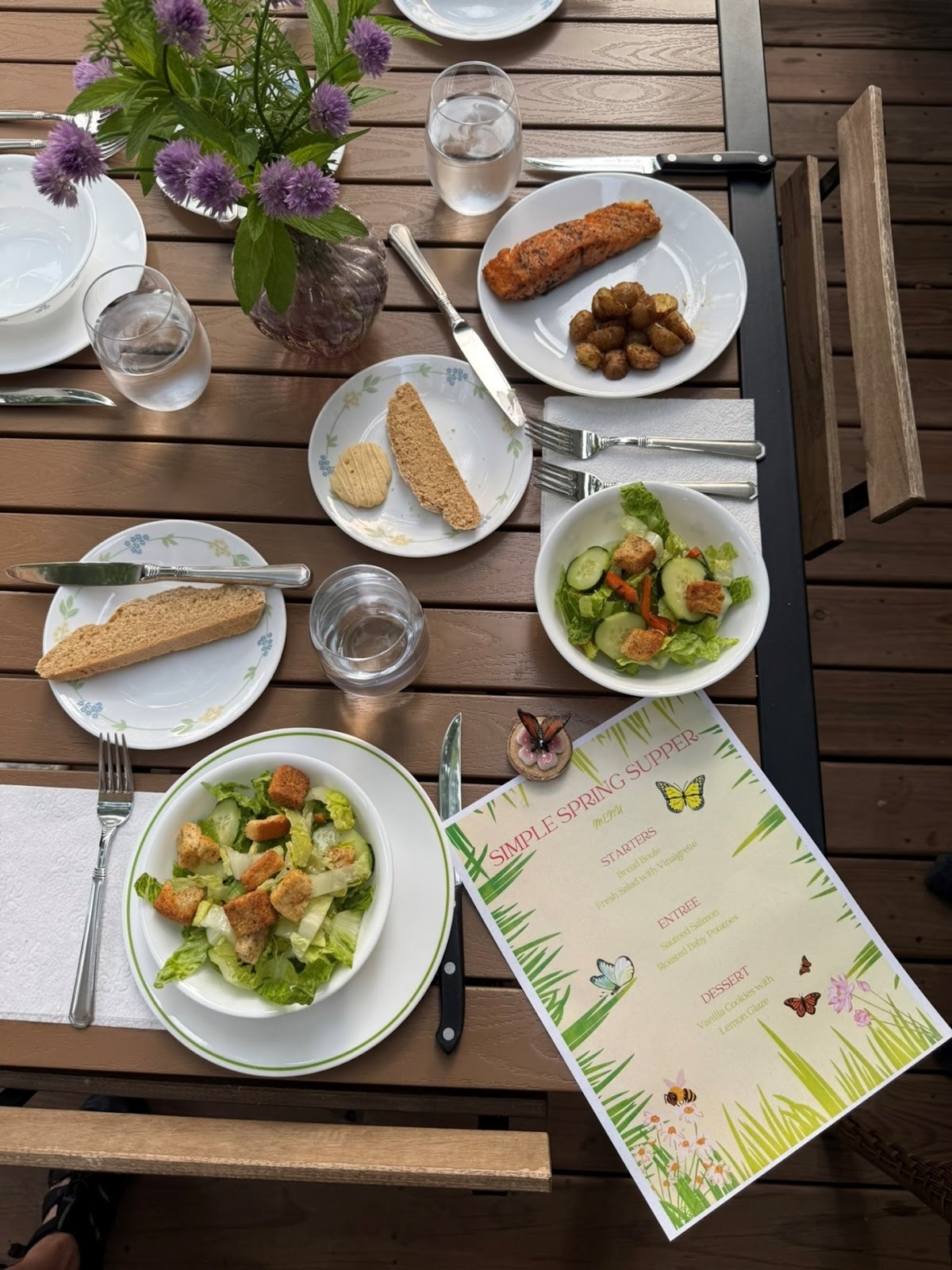
Photo Credit: Kieran Nielsen
There have been countless studies proving the importance of “active learning.” Take a look at this study from Carnegie-Mellon University to find out which methods were most conducive to lasting learning.
If you’re interested in finding out more about engaging your brain and body in learning, be sure to read Part 2 for more science-backed reasons!
This blog series is written by NSA teacher Shauna Mingus. Learn more about Shauna here!